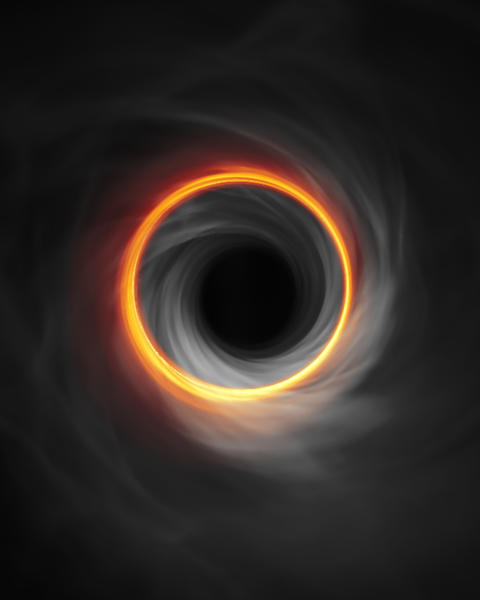
Black holes would seem impossible to visualize: they emit no light and reflect none. They have an event horizon, which, in a rigorous sense, marks the edge of the universe. Despite this, in 2019, the Event Horizon Telescope (EHT) directly imaged the billion-degree gas orbiting the supermassive black hole M87*. Now, a team from that effort is working to build a space telescope (Black Hole Explorer, BHEX) to join terrestrial telescopes to observe the photon ring, a shell of pure light that captures everything there is to know about a black hole: mass and spin.
However, creating an image of a photon ring boils down to solving a complex Bayesian inverse problem. Solving this inverse problem will push statistical methods to the brink. The imaging model has millions of parameters that are non-linearly related to the data, a hierarchical model structure, and requires analyzing petabytes of data. In this talk, we will present efforts to jointly leverage novel computational hardware with AWS, along with new statistical techniques that scale to highly parallel computing environments, to unveil the chaotic environment around black holes, pushing our scientific knowledge to the horizon.